What Did I Learn in Here?
At the beginning of this semester, I saw writing mainly as a task that had to be completed correctly by following certain standards taught in high school. By taking ENG 110, it challenged how I viewed writing. Through course readings, personal narratives, peer reviews, and Translation projects, writing turned into a tool for delivering meaningful ideas, reflection and communication across different audiences.
One of the most significant things I learned this semester is that standard academic English is not the only effective or valid way to deliver a message. In the past, I believed academic writing required sounding formal, even when it means distancing myself from my own voice. Readings such as Amy Tan’s personal narrative “Mother Tongue” and Nate Marshall’s poem “Finna” challenged this belief. In “Mother Tongue,” Tan explains that her mother’s “broken” English was often viewed as limited by others. However, through her writing Tan was able to present that her mother’s language was full of emotions and meanings. Similarly, in “Finna” Marshall uses AAVE throughout the poem to normalize it rather than present it as improper. Together, these readings helped me understand that language does not lose value when it does not follow standard. In reality, non-standard language can express authenticity, culture, and lived experiences of a writer more effectively than forced formality. I applied this understanding to my LLN, where I wrote about moving from Uzbekistan to the United States and the process of learning English in a new environment. Instead of forcing my story into limited layout and words that I do not use in my everyday life, I focused on writing in my own voice. This way of writing helped my narrative to be more personal and reflected myself.
Another major learning outcome for me was the importance of writing as a process rather than one step task. In the past, I would get to writing immediately without planning, which often left me stuck or frustrated. In ENGL 110, I was introduced to strategies such as brainstorming, drafting, peer review, reflection, and revision. I found reflections to be most helpful in the writing process because it allowed me to see weak and unclear parts of my work. Reflecting on my work helped to make more intentional changes. In my cover letter for the LLN, I wrote “My first draft was more like a list of events that didn’t connect well or show reflection.” Looking back at my drafts helped me see how I progressed over time. Peer reviews further assisted to improve, giving suggestions such as focusing on specific moments instead of covering my entire experience. This helped me narrow my focus and better adjust my writing for the audience I wrote.
Another important skill I developed this semester was using sensory details to further immerse the reader. Before this course, I rarely included sensory details. In one of the in-class writing we were asked to describe our day right before class using sensory details. I wrote, “After I finished praying I saw a little cat roaming around the room, petting its soft warm fur, and hearing its purring. In the background was the sound of cars and middle schoolers dismissed from school.” Using sound, touch, and setting made the moment feel more real. I applied this in my LLN as well, “My pulse sped up. I whispered to myself, rehearsing what to say before words came out of my mouth.” These sensory details made my experience more vivid and allowed readers to feel the emotion rather than simply read about it.
The Translation 2 project helped me understand that visuals can be a great tool to deliver a message, sometimes without words.
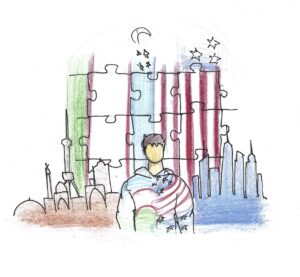
In my drawing, I tried to represent identity and how living between two different cultures creates a unique one. One of the symbols I used was puzzle pieces. The puzzle represents how identity is formed from different parts and how they contribute to the whole identity. Creating this drawing helped me understand that communication is not limited to written text. Visuals can express emotion, conflict, and meaning that words may not capture as much, just like posters we analyzed in class like “Silence=Death” and others.
Looking back at the beginning of the fall I can see the improvements I made as a writer. From viewing writing as a task that needed to be completed, to understand it as a way to communicate different ideas with intention. While I had challenges like struggling to finish assignments or feel unsure of my voice in my work, those difficulties were part of the growth. Throughout the semester I gained confidence in expressing myself, revising ideas, and choosing language that reflects who I am. ENGL 110 helped to understand writing as a continuing process. I am ending this course with stronger skills that I will carry on improving in the next stage of college.
Works Cited
Marshall, Nate. “Finna.” Wild Hundreds, University of Pittsburgh Press, 2019.
Tan, Amy. “Mother Tongue.” The Threepenny Review, no. 43, 1990, pp. 7–8.
Silence = Death. Gran Fury, 1987.

